
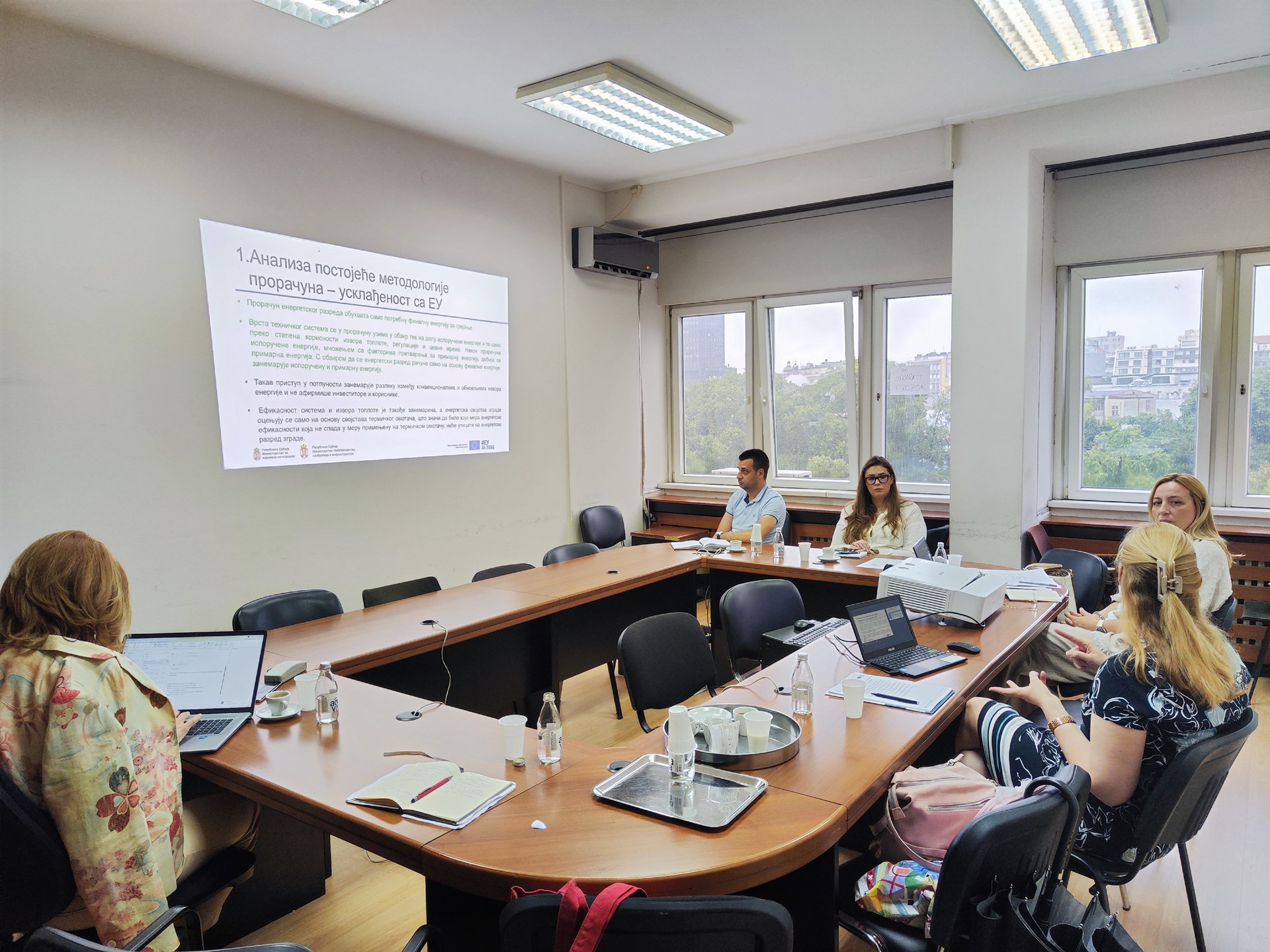
As part of the activities of the PLAC IV project, which focuses on aligning Serbia’s legislation with the EU’s acquis communautaire, a detailed analysis was conducted on the current methodology used for calculating the energy performance of buildings for the purpose of energy certification. The objective of the analysis was to assess its compliance with relevant standards and with EU Directive 2024/1275 on the energy performance of buildings (EPBD), in the context of preparations for Negotiation Chapter 15 – Energy.
At a working meeting held at the Ministry of Construction, Transport and Infrastructure on 17 July 2025, project expert Prof. Dr. Tamara Bajc presented the analysis to the participants. The analysis included the following steps:
- Analysis of the existing calculation methodology – including the standards used and its alignment with EU regulations.
- Overview of key differences between the current calculation methodology and the requirements of ISO 52000-1, 52003-1, 52010-1, 52016-1, and 52018-1.
- Analysis of the EPBD requirements, the existing methodology, and ISO standards 52000-1, 52003-1, 52010-1, 52016-1, and 52018-1, which covered algorithms for calculating the energy performance of buildings and examples of defining energy performance criteria from various European countries.
- Recommendations for aligning the current methodology with the changes introduced in the EPBD.
- Development of National Data Sheets for the energy needed for heating and DHW (domestic hot water) for the key ISO standards 52000-1, 52003-1, 52010-1, 52016-1 and 52018-1.
During the analysis, it was established that improvements to the existing methodology are particularly needed in the following areas:
- Harmonizing the definition of a building, thermal envelope boundaries, and methodology selection – it is necessary to align these elements with the EN ISO 52000-1 standard.
- Establishing a national database for climatic characteristics – a reliable database with climate data for different locations across the Republic of Serbia needs to be developed.
- Improving the mathematical calculation model – it is necessary to incorporate all relevant standards into the energy performance calculation model.
- Improvement of the conversion factor from delivered to primary energy in order to promote the use of renewable energy sources.
- Defining energy performance indicators for the Republic of Serbia – such as mandatory indicators like primary energy per square meter and the share of renewable energy, to establish the nZEB (nearly zero-energy buildings) level.
- Development of simulation software – the development of national software is necessary.
- Defining reference buildings and indicators through simulations for various locations, building categories, and construction periods.
- Defining energy classes by construction period, building category, and potential for nZEB both for individual buildings and for the average values of the building stock.
- Improvement of the certificate layout – alignment with recommended standards and inclusion of key indicators.
After the conducted analysis, it was recommended that all necessary amendments to the methodology be implemented in accordance with the applicable standards and the EPBD, selecting an appropriate time interval for calculations. During the working meeting, expert Tamara Bajc highlighted the advantages and disadvantages of the hourly and adjusted monthly calculation methods and emphasized that the calculation method should be defined at the national level through future amendments to the methodology.
Implementing these recommendations is an important step toward alignment with European standards in the field of building energy efficiency, which is a prerequisite for the successful closing of Negotiation Chapter 15, and one of the necessary steps on Serbia’s path toward EU accession.