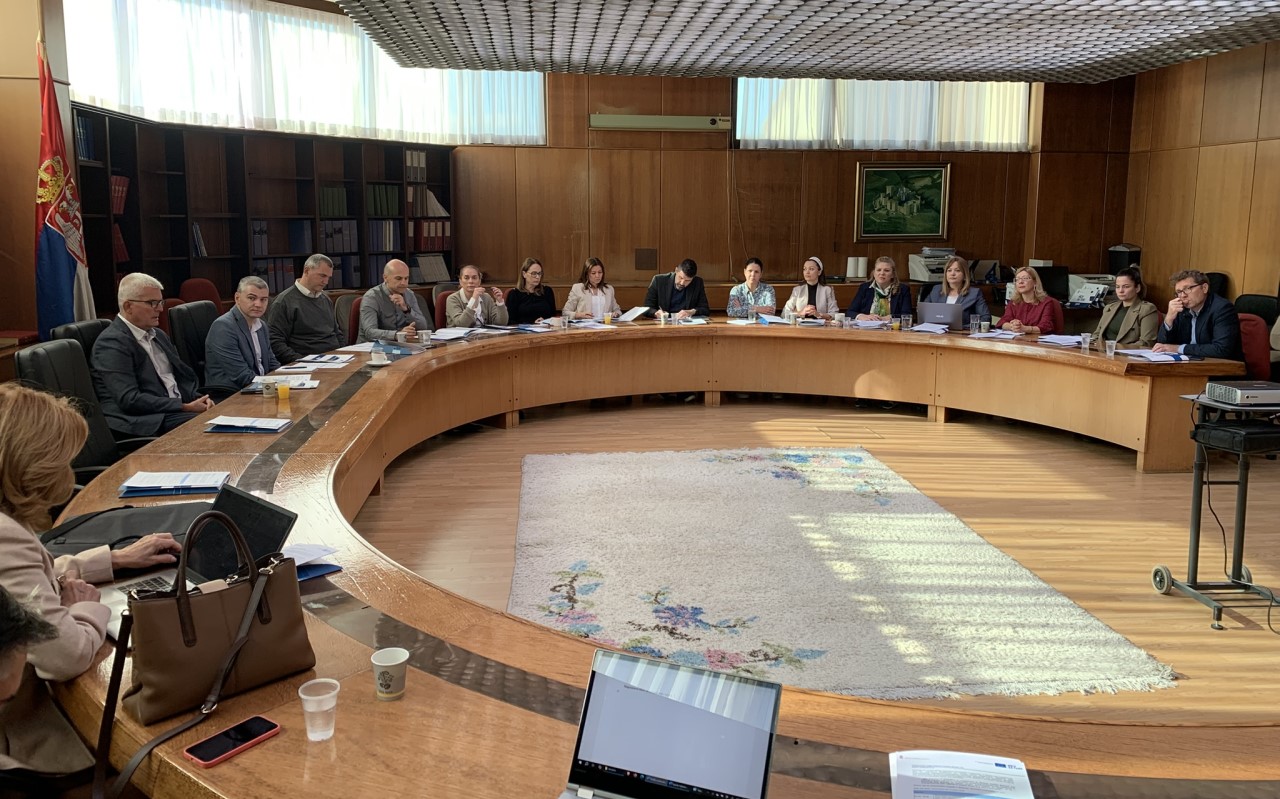
On 8 October 2025, a workshop was held at the Securities Commission of the Republic of Serbia dedicated to analysing Serbia’s regulatory framework for preventing market abuse in the capital market and its alignment with the EU legal framework in this area. The workshop was organised in the scope of the PLAC IV project, in cooperation with the Securities Commission, which is also the beneficiary of this activity, as part of fulfilling obligations in the EU accession process within Negotiating Chapter 9 – Financial Services. Harmonisation of this regulatory area will contribute to capital market stability, greater investor confidence, and better protection of the financial interests of Serbia’s citizens and businesses.
The workshop was opened by Prof. Dr. Dijana Marković Bajalović, the PLAC IV project’s Key Legal Expert, who, in her introductory remarks, illustrated the importance of the topic with a practical example and stressed that improving the regulatory framework is crucial for a safe, stable, and transparent financial market in Serbia. The workshop brought together a significant number of experts from the Securities Commission, who had the opportunity to familiarise themselves with the results of the GAP analysis prepared by Karlo Nikolovski, the PLAC IV project expert in the field of capital markets, who is also from the Croatian Financial Services Supervisory Agency (HANFA).
Analysis and comparison with European standards
For the needs of the Commission, the PLAC IV project prepared a detailed GAP analysis of the alignment of the Law on the Capital Market of the Republic of Serbia (OG 129/2021-19) with EU Regulation No. 596/2014 on market abuse (MAR) and Directive 2014/57/EU on criminal sanctions for market abuse (MAD). The analysis also covered by-laws, measures for detecting and proving abuses, as well as recommendations for amendments to the existing legislation. The workshop further presented four drafts of new by-laws—rulebooks and guidelines relating to market surveys, accepted market practices, share buy-back programmes and price stabilisation, as well as additions to the existing rulebook that defines manipulative indicators and measures for detecting and reporting suspicious transactions.
 During the workshop, the results of the GAP analysis and the drafted acts were presented in greater detail. Following the presentation of the analysis, the project expert, Mr Nikolovski, gave an in-depth overview of the experience of the Croatian Financial Services Supervisory Agency, its organisational structure, and the IT tools used in capital market supervision and in detecting manipulative activities, emphasising how crucial modern analytics is in preventing abuse. Participants had the opportunity to discuss key practical challenges in applying these EU regulations with their colleague and, through simulated scenarios, to see in practice how cases of market abuse are detected and prosecuted in the EU.
In response to a question about the innovations that aligning Serbia’s law with the MAR/MAD framework will bring, Mr. Nikolovski emphasized:
“By continuously monitoring the latest amendments to the EU regulatory framework on market abuse and aligning with those amendments through their implementation in national legislation, the Securities Commission is ensured the ability to apply the same standards, principles, and requirements on the regulated market in the Republic of Serbia as those applied on the regulated markets of EU Member States.
Personally, I believe PLAC IV is the kind of project that provides an exceptionally good opportunity for the exchange of practical experience between experts and, in this specific case, the staff of the Securities Commission—where the exchange of views and experiences can often contribute to solving particular challenges that arise in day-to-day work.”
Karlo Nikolovski, PLAC IV project expert and HANFA official, Specialist for Supervision and Analysis – Team Coordinator in the Directorate for Supervision of Market Infrastructure and Market Abuse.
Since its inception, the PLAC IV project has worked closely with the Securities Commission to meet Serbia’s obligations under Negotiating Chapter 9 – Financial Services, providing specialized technical support to align Serbia’s capital market with EU rules and practices. In the course of 2025, numerous joint activities were organized, notably a Workshop on the operational rules and tariff list of the Central Securities Depository and Clearing House, a Presentation of the EU Markets in Crypto-Assets Regulation (MiCA) and Gap Analysis of the Law on Digital Assets, as well as work related to drafting the new Law on the Takeover of Joint-Stock Companies.
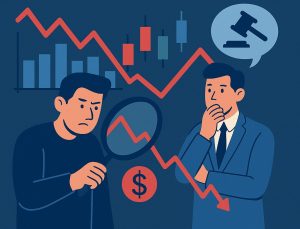
Examples of forms of behaviour that constitute market abuse
(as defined in Annex II to the Regulatory Technical Standards (RTS 2016/522))| 1 | Establishing the floor, ceiling or corridor of the price of a financial instrument | Trading with the intention of increasing, decreasing, or maintaining a share price at a level that affects derivative instruments, the average price, or margin calculations. |
| 2 | Collusion in the after market of an IPO | Investors coordinating purchases of shares after an IPO in order to create artificial demand and then selling them at an artificially inflated price. |
| 3 | Abusive squeeze | Manipulating the supply of or demand for a financial instrument to cause price dislocations and make deliveries more difficult for other market participants. |
| 4 | Ping order | Entering small, rapid orders to detect other participants’ hidden orders, often in the context of algorithmic trading. |
| 5 | Phishing | Executing a series of orders to discover the size of hidden (“iceberg”) orders and exploiting the information obtained in subsequent trading. |
| 6 | Quote stuffing | Submitting and cancelling large volumes of orders in order to overload the market and slow other participants’ responses. |
| 7 | Wash trade | Artificially creating the impression of heightened activity or demand by trading between related parties without any real change in ownership. |
| 8 | Painting the tape | A series of transactions designed to create the appearance of increased activity or price stability so as to influence market perception. |
| 9 | Layering and spoofing | Placing a large number of orders on one side of the order book to create false demand or supply and then withdrawing them after executing the opposite side transaction. |
| 10 | Marking the close | Buying or selling at a specific time of day (at the market open or close) in order to alter the reference price. |
| 11 | Momentum ignition | Orders aimed at initiating or amplifying a trend and prompting other participants to follow it for profit. |
| 12 | Pump and dump | Purchasing an instrument and disseminating misleading positive information to push up the price, followed by selling at that artificially high level. |
| 13 | Smoking | Deceiving “slower” traders through sudden order changes in order to profit from their reactions. |
| 14 | Improper matched orders | Coordinated purchases and sales of the same instrument at the same time and price to create a false impression of market activity or price. |
Photo gallery